
Search for Anthropic in a stock app and, until its IPO prices, you still get nothing: no ticker, no chart. In Tickers for the Tickerless it has the steepest chart on the board: six reported valuation points between May 2023 and May 2026, from $4.1B to $965B, each with its round, its date and its source attached. Here is how to read it, using only what the tool shows. The short explainer covers how the board works; this post is the Anthropic line itself.
1. What a point on this chart is
A point is a post-money valuation reported at a named funding round on a specific date. It is a negotiated price between the company and the investors in that round, reported by a named source, and it is neither a market price nor an official disclosure: private companies file no valuation with anyone. The tool keeps four kinds of points apart (primary rounds, tender offers, secondary sales and reported talks, the last drawn hollow and never counted as closed). All six of Anthropic's points are primary rounds. The line joining them is a drawing aid; the points are the data, and between two points the chart knows nothing.
2. The six marks, in order
May 2023, Series C, $4.1B. Anthropic did not disclose a Series C valuation; $4.1B is the figure reported by CNBC and The Information. March 2024, the Amazon strategic investment, $18.4B, as reported by Bloomberg. March 2025, Series E, $61.5B, announced by Anthropic itself. September 2025, Series F, $183B, announced by Anthropic. February 2026, Series G, $380B, announced by Anthropic. May 2026, Series H, $965B, as reported by Bloomberg, and labelled in the tool as the company's last private mark.
Read the spacing, not just the sizes. The first three points span almost two years; the last three arrive inside eight months, $183B, $380B and $965B between September 2025 and May 2026. End to end, the reported mark multiplied about 235 times in three years. The latest step, Series G to Series H, is 2.54x. The biggest single step is the first one: 4.49x, from the Series C to the Amazon strategic investment.
3. The revenue line changed its source
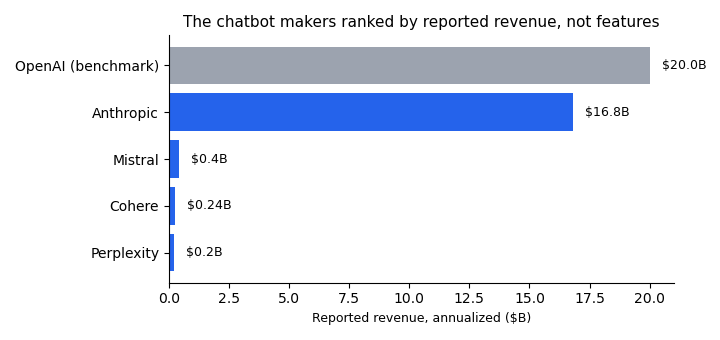
A best-chatbots list with a different sort key
Zapier's best AI chatbots page, the winning publisher for this cluster, ranks assistants by what they can do. This page ranks the same shelf by what their makers report earning, using the Tickerless board's recorded revenue points (the board tracks 12 private AI companies, 65 reported valuation points and 25 reported revenue points, every one sourced). Only five of the twelve companies make a general assistant, and only those five are ranked here. The order will not match a feature list, which is the point: revenue is the staying-power column, and on it the field splits into two companies and a tail.
The ranking
| Assistant | Maker | Latest reported mark | Reported revenue (annualized) | Revenue per $100 of mark |
|---|---|---|---|---|
| ChatGPT (benchmark) | OpenAI | $840B | $20B | $2.38 |
| Claude | Anthropic | $965B | $16.8B | $1.74 |
| Le Chat | Mistral AI | $24B | $400M | $1.67 |
| Command | Cohere | $7B | $240M | $3.43 |
| Perplexity | Perplexity | $30B | $200M | $0.67 |
Anthropic's Claude business reports $16.8 billion annualized, close enough to OpenAI's $20 billion benchmark to make it a two-company race. Then the cliff: Mistral's Le Chat sits on $400 million, Cohere on $240 million, Perplexity on $200 million, two orders of magnitude below the leaders. The last column is the connoisseur's cut: Cohere carries the richest revenue per dollar of mark at $3.43 per $100, richer than OpenAI itself, while Perplexity carries the thinnest at $0.67, a $30 billion mark resting on the board's smallest assistant revenue, and a mark that is itself a round reported to be in talks rather than closed.
What the money column cannot rank
Revenue says nothing about which assistant answers best, and the board's other seven companies are absent here for a reason: Databricks, Scale AI and xAI sell infrastructure and models to businesses, Anysphere sells a coding tool, ElevenLabs voice, Harvey legal software, Figure AI robots. Three of the twelve, xAI, Figure AI and Scale AI, record no revenue point at all, so even their makers' money is unreported. Reported revenue is also a snapshot each company chose to publish, at different dates, unaudited. Read the table as the market's rough ledger, not as a review score, and run the underlying charts yourself in Tickers for the Tickerless. Sources: the modeled page is Zapier's best AI chatbots; all figures are the board's recorded, press-reported points, as captioned.