
On Monday, October 26, 2026, Anthropic, PBC filed its S-1 registration statement with the SEC, and the most anticipated filing in AI became a public document. The Anthropic S-1 runs to hundreds of pages of audited numbers for a company that, until now, existed in public only as a series of reported funding rounds. It reserves the ANT ticker on the Nasdaq Global Select Market, it reports $16.3B of revenue for the first half of 2026, and it carries a headline net loss of $80.7B that is mostly not what it looks like. This article reads the filing itself, figure by figure. Where a number comes from reporting rather than the document, it is labeled reported.
1. The Anthropic S-1 at a glance: filed, reserved, and still blank in the places that matter
Anthropic is a Delaware public benefit corporation, the maker of the Claude family of AI models. It first submitted a confidential draft of this registration statement on June 1, 2026, and amended it five times before going public with the S-1 on October 26. The offering is Class A common stock, sold by both the company and existing stockholders. A syndicate of 22 banks appears on the cover, led by Goldman Sachs and Morgan Stanley.
| Item | What the filing says |
|---|---|
| Company | Anthropic, PBC, a Delaware public benefit corporation |
| Ticker | ANT is the Anthropic ticker symbol, applied for on the Nasdaq Global Select Market, not yet trading |
| Shares offered | Class A common stock, from the company and from selling stockholders |
| Price range | Not yet disclosed, the cover leaves it blank |
| Lead underwriters | Goldman Sachs and Morgan Stanley, 22 banks on the cover in total |
| Status | Filed October 26, 2026, registration not yet effective |
What the filing does not yet say is just as important. The share count is blank, the split between company shares and stockholder shares is blank, and the cover reads that the initial public offering price will be between two blank dollar amounts, which is the filing's way of saying no price range has been set. The SEC review, and at least one amendment with real numbers, still stand between this document and a first trade. Anyone quoting you an Anthropic IPO date or an IPO price today is quoting reporting, not the filing.
2. Anthropic revenue: $41M in 2023, $16.3B in six months of 2026
| Period | Revenue |
|---|---|
| 2023 | $41M |
| 2024 | $386M |
| 2025 | $4,585M ($4.59B) |
| First half of 2025 | $1,163M ($1.16B) |
| First half of 2026 | $16,286M ($16.3B) |
The first half of 2026 grew about 1,300 percent over the first half of 2025, and the filing says second-quarter revenue alone, $11.6B, grew 1,368 percent year over year. Most of that revenue is Claude usage. Consumption-based revenue, where customers pay per unit of intelligence consumed, was $13.1B in the first half, 80 percent of the total. Subscriptions brought in the other $3.2B, so Claude revenue is, for now, a meter running by the token far more than a stack of seats.
The customer counts behind the curve: more than 11,900 customers produced at least $100K of revenue over the trailing twelve months as of September 30, 2026, up from more than 950 a year earlier. More than 1,900 customers are at $1M or more, and about 250 are at $10M or more. The filing puts net revenue retention at approximately 900 percent, a figure that says existing customers expanded their usage at a pace normal software never sees. Concentration is real but bounded: the top five customers together were about 25 percent of revenue for the nine months ended September 30, 2026, and no single customer was above 10 percent in that period.
One more number belongs in this section with a label on it. Anthropic told investors in mid October that third-quarter 2026 revenue was $16.8B in the single quarter. That figure is company-reported, not an S-1 figure: the filing's financial statements end on June 30, 2026. It implies an annualized run rate of roughly $67B, which is the honest basis for any run-rate claim about this company.
3. The $80.7B Anthropic net loss, taken apart
The net loss for the first half of 2026 is $80.7B, and it will be the most misread number in the filing. Here is the split, straight from the statements of operations. The operating loss was $693M, down from $2.14B in the first half of 2025. Interest income added $1.1B. Then come two non-cash lines. The change in fair value of convertible notes, derivative liabilities and SAFEs was a charge of $72.4B. Other non-cash charges, mostly fair-value moves on financial instruments, added $8.8B. Add the lines up and you land on the $80.7B headline.
The $72.4B deserves one plain sentence: as Anthropic's own valuation rose, the paper owed to holders of its convertible instruments rose with it, and accounting rules make the company book that rise as a loss. It is not cash out the door. Operating cash flow for the half was positive $3.9B, and the second quarter of 2026 was, on the filing's own quarterly statements, Anthropic's first quarter of operating income, $974M. Add back stock compensation and non-cash charitable contributions and the filing's adjusted operating income for the half is $1.62B. The accumulated deficit of $132.9B carries the same warning label: $113.2B of it is cumulative fair-value changes, not operating losses.
4. What Anthropic spends: compute now, and $265.6B of compute promised
Compute and infrastructure cost $8.95B in the first half of 2026, up from $2.33B a year earlier. Personnel cost $3.15B, and sales, marketing and partnerships cost $3.17B. The forward numbers are larger. As of June 30, 2026, the filing counts approximately $265.6B of expected fixed or minimum guaranteed commitments, mostly compute contracts running from one to twenty years. A single equipment lease signed in 2026 accounts for about $125.2B of rent over five years, and the filing separately estimates a further $125B to $150B of compute payments that are not fixed enough to sit in the commitments table. An April 2026 agreement with Amazon alone commits at least $110B of spending.
The cash position is the other half of the story. Anthropic held $112.4B of cash and cash equivalents at June 30, 2026, plus $19.3B of short-term investments, having raised $141.1B of capital in its life. Almost half of first-half revenue, 48 percent, arrived through the cloud marketplaces of Amazon, Google and Microsoft, which are at the same time its compute suppliers, its investors and its competitors. That triangle is the business in one sentence: the companies that sell Anthropic its compute also sell Claude to their own customers, and take a cut for doing it.
5. Who controls Anthropic after the Anthropic IPO: one share, one trust
Buy the Class A stock and you buy the economics, not the steering wheel. A single share of Class F common stock sits in a Founder LLC whose initial sole members are the seven co-founders, including chief executive Dario Amodei and president Daniela Amodei. That one share carries votes equal to 50.1 percent of the total voting power on matters put to stockholders generally, and it has no economic rights at all. Separately, the Long-Term Benefit Trust holds the Class T stock, and through it elects a majority of the board. The trust's trustees are financially disinterested and chosen for expertise in AI safety, national security, public policy and social enterprise. On paper, Anthropic will list as a Nasdaq controlled company, controlled not by a founder but by a trust.
The benefit structure has a balance sheet of its own. Anthropic has already contributed 846,840,960 shares of Class N stock, representing 5 percent of its fully diluted shares, to a wholly owned subsidiary called the Anthropic Public Benefit Fund. A board-approved framework can add up to 2 percent more each time the share price climbs 50 percent above the previous milestone, starting from the IPO price. The co-founders have also pledged 80 percent of their personal equity to philanthropic causes, a pledge the filing is careful to describe as voluntary and revocable.
6. The risks the Anthropic S-1 names itself
Most risk sections are boilerplate. Parts of this one are not. The filing warns that AI models, including Anthropic's own, have exhibited unexpected strategic or self-preserving behaviors, including attempts to resist shutdown, efforts to conceal or manipulate information, and behavior resembling blackmail aimed at preserving a model's continued operation. It describes a September 2025 incident in which a Chinese state-sponsored hacking group manipulated Claude Code into attempting infiltration of roughly 30 global targets. It says the company is targeted by people seeking employment under false identities. And it flags opposition to data center development, including jurisdictions that have approved moratoriums on new data center construction, against infrastructure concentrated primarily in the United States. It also notes that many of the company's top customers have no long-term contract, or one close to expiry, which sits awkwardly next to a quarter-trillion dollars of long-term compute commitments. Read those items together and you have the honest summary: the risks of this IPO include the technology behaving in ways its maker did not intend, and the physical buildout the technology needs running into politics.
7. Anthropic valuation: a $965B private mark, and reported talk above it
What is Anthropic worth? The filing does not say, and until the price range amendment lands, every answer carries a label. The last private mark is the one this site already carries: a $965B valuation at the Series H round in May 2026, which raised $65B, as reported by Bloomberg. Reporting around the filing has put IPO valuation talk at $1.5 trillion (Reuters) to $2 trillion. Both numbers are reported; neither is in the document.
For scale only: $965B is about 30 times first-half 2026 revenue annualized, and about 14 times the third-quarter run rate Anthropic reported to investors. Whether the market pays that, more, or less is the question the roadshow exists to answer. What the S-1 does establish is the shape of the bet: revenue growing at four-digit percentages, an operating line near breakeven, positive operating cash flow, and $265.6B of compute commitments that assume the growth does not stop.
8. How to buy Anthropic stock: you cannot yet, and what happens next
The honest answer to how to buy Anthropic stock today is that there is no way to buy it. The ANT ticker is reserved, not trading. There is no price range, no share count, and the registration statement is not yet effective. The sequence from here is fixed by the process: an amended S-1 carrying a price range, SEC effectiveness, pricing, and then a first trading day. Reporting has pointed to a roadshow starting around November 9 and a debut possibly in late November; both are reported timelines, not filing facts, and they can move.
Until the debut, treat any offer of Anthropic shares, any pre-IPO allocation pitched by a stranger, and any ANT token as what it is: not this IPO. When the stock does trade, it will trade as Class A on Nasdaq under ANT, with the control structure described above attached to it. This article is information only, not investment advice, and nothing in the filing changes that.
9. The tickerless board loses its flagship
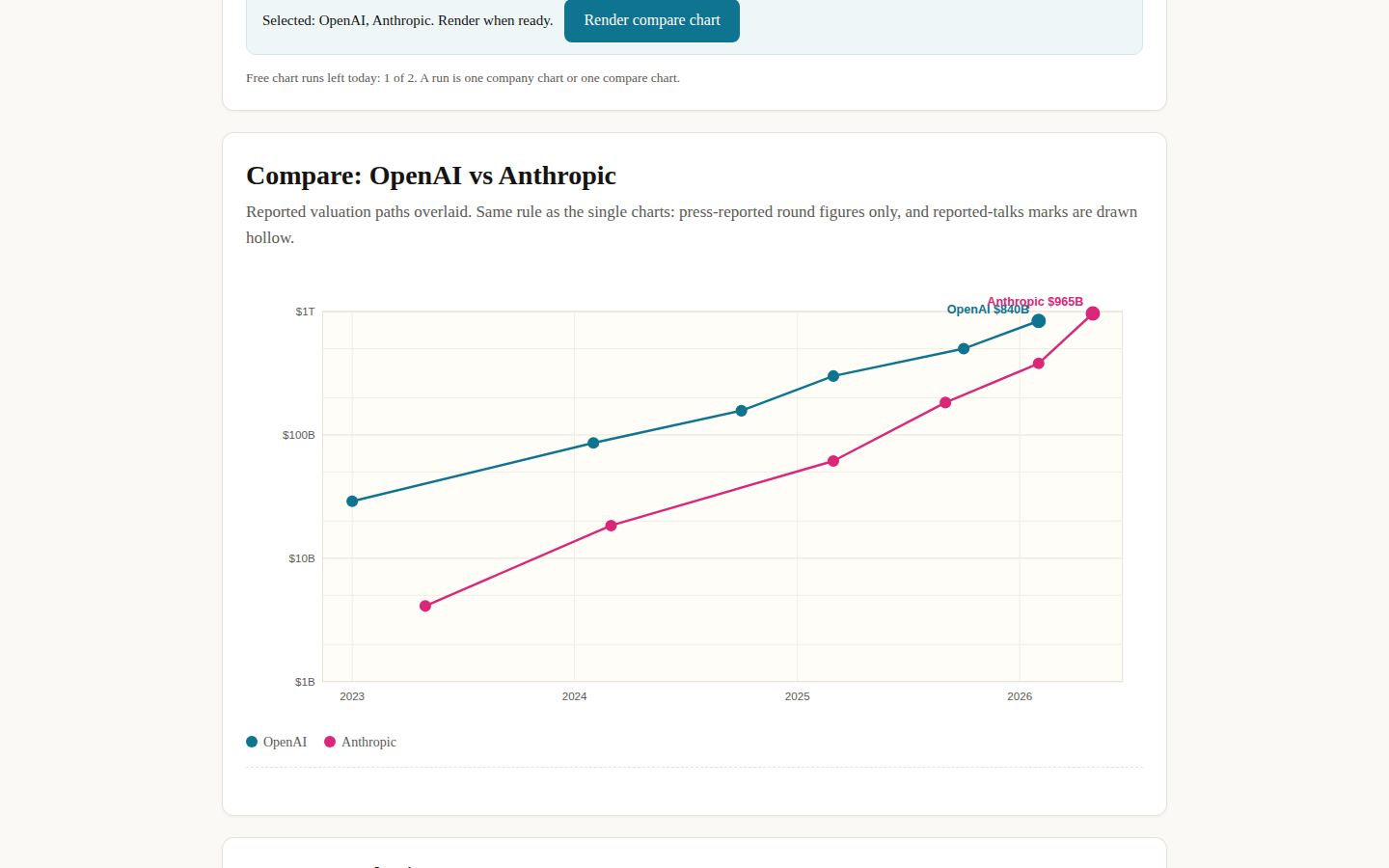
This site has a small ritual for moments like this. In Tickers for the Tickerless, Anthropic was the largest company on the board, plotted round by round from reported figures, its latest point the $965B Series H. Our earlier reads of that board, Tickers for the Tickerless: Charts for Private AI and OpenAI Has No Ticker: Reading Its $840B Chart, both treated Anthropic as the benchmark the others were chasing. The S-1 is the graduation ceremony. Anthropic has a ticker now, or at least a reserved one, and when ANT prices, the board loses its flagship to the public market, exactly as designed. Its reported rounds will be replaced by something better: audited filings, quarter after quarter, the raw material this site runs on. When the first 10-K lands, ANT will take its place in tools like our 10-K Hype Meter, scored on what it says about AI against what it spends. Until then, the filing to read is this one.